
How to count goats: through a race, in the yard and in the paddock
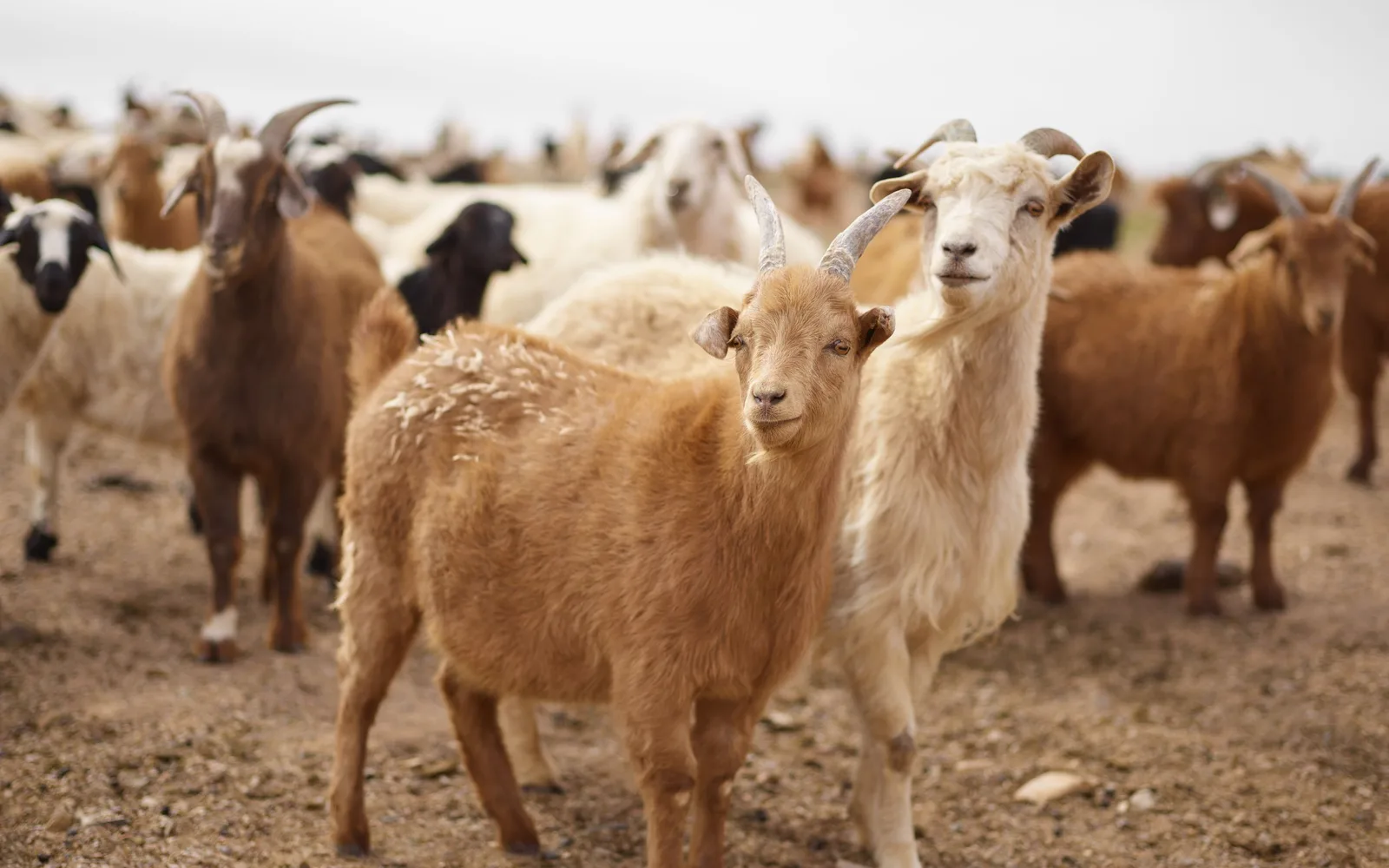
The only reliable way to count goats is one at a time through a narrow race or drafting gate, because goats do not behave like sheep: a mob of them scatters rather than holds together once it is on the move (Meat & Livestock Australia 2017). New South Wales guidance on goat yard design recommends a V shaped working race only 500 to 600 mm wide so goats pass through one by one (NSW DPIRD 2003). Counting a loose mob by eye in a paddock is much harder, and even helicopter surveys of feral goats can double count animals that move between passes (Tracey and Fleming 2023). Photo counting apps are a newer option for a paddock check, but they are not yet tested on large mobs.
Why is counting goats different from counting sheep or cattle?
Goat behaviour is the whole reason goat yards look different from sheep and cattle yards. New South Wales government guidance on yard design is blunt about it: "Goats do not behave like sheep. Goats should be handled quietly and without force, using only nonaggressive dogs" (NSW DPIRD 2003). Four traits matter most for anyone trying to count them: intelligence, since goats "quickly learn the run of a set of yards" but become "very wary and difficult to handle" in areas where they have been stressed; agility, since in a packed race "a rogue animal can even run over the top of the mob and out of the race"; flightiness, since goats "pack together very easily in small yards and working races", with heads, legs and horns becoming entangled; and alertness, since goats "baulk readily at distractions such as shadows and human arms crossing the drafting race" (NSW DPIRD 2003). Vision plays a part too: MLA describes a goat's field of view as "320 degrees to 340 degrees with only a small blind spot behind them", plus binocular vision of 20 to 60 degrees, so a goat "can detect movement behind them without moving their heads" (Meat & Livestock Australia 2017).
The biggest difference for counting, though, is movement and mob structure. Meat & Livestock Australia (MLA) notes that "goats have a hierarchical or mob structure", often with a dominant male or older doe leading, and that "guiding the mob leaders will encourage the rest to follow" (Meat & Livestock Australia 2017). But that structure does not hold a mob together the way a flock instinct does: "Goats move as a mob when grazing in large paddocks containing trees and shrubs but will tend to disperse when mustered. This behaviour is very different to sheep which will tend to bunch together while being moved" (Meat & Livestock Australia 2017). That same tendency is why the Condobolin yard design described by NSW DPIRD used shorter, narrower races than a comparable sheep yard: "goats are less gregarious and more prone to stop and turn than to follow their 'mates'" (NSW DPIRD 2003). For a comparison of the two species more broadly, see how to tell sheep from goats.
How do you count goats through a race or gate?
Turning a mob into a single file line is still the most accurate way to get an exact number, but goat races are built to different dimensions from sheep or cattle races because of the behaviour above. NSW DPIRD guidance recommends a drafting race about 3 m long (2.5 to 4.0 m, about 9.8 ft, our arithmetic using conversion factors from National Institute of Standards and Technology n.d.), V shaped with a top 600 mm wide and a bottom 280 mm wide "to allow easy movement for bucks and big horned does", sides smooth and 900 mm high (about 35 inches, our arithmetic): shorter and "the operator does not have enough time to make a decision for drafting", longer and goats baulk. The working race runs 8 to 10 m long (about 26 to 33 ft, our arithmetic), divided by gates into sections under 3 m. For yards used only for goats, the guidance narrows the working race to 500 to 600 mm (about 20 to 24 inches, our arithmetic) in a single width "V" shape, which "is much easier on both the goats and the operator, and prevents turning and jumping". Drafting gates should be 1200 mm long, with open rail gates preferred because goats can see through them (NSW DPIRD 2003).
Not every goat yard follows a sheep shaped race. Some producers count from a catching pen instead, filled to about two thirds capacity "to avoid smothering", where each animal is caught, counted and worked individually: slower, but it avoids some problems of a packed race (NSW DPIRD 2003). Our guides to how to count cattle and how to count sheep cover the gate and race methods for those species, which share the same single file principle even though the dimensions differ.
Good yard design does most of the work before anyone starts counting. NSW DPIRD guidance says yards should avoid dark areas, shadows or dead ends that cause baulking, since goats are "attracted to light", and that goats should cross a slope rather than go up or down it, since moving downhill they can gain enough momentum to jump or climb (NSW DPIRD 2003). Existing sheep yards can be used for goats, but "may require an extra rail for additional height in high pressure areas as goats are more inclined to jump and climb than sheep" (Meat & Livestock Australia 2017). A race that stops baulking and jumping before it starts is, in practice, the same thing as a race that gives an accurate count.
Why is glance counting a mob of goats unreliable?
Two problems stack on top of each other in a paddock. The first is human: taking in a group of animals at a glance only works for small numbers. Laboratory research on counting describes "subitizing", the instant recognition of quantity, as working for "fewer than 4 items", where it is "rapid (40 to 100 ms/item), effortless, and accurate". Once there are more than 4 items, people switch to actual counting, which is "slow (250 to 350 ms/item), effortful, and error-prone" (Trick and Pylyshyn 1994). That research used dots on a screen, not goats, but it explains why a glance at a mob of a dozen or more animals cannot give an exact number.
The second problem is the goats themselves. Because goats disperse rather than bunch when disturbed (Meat & Livestock Australia 2017), a mob in open country rarely stands still or grouped together long enough for a careful count to be sure nothing has been missed or counted twice. Goats can also pack tightly in yards, where "heads, legs and horns can become entangled" (NSW DPIRD 2003), hiding individual animals the other way, inside a crowded pen rather than spread across a paddock.
Can you count goats from the air or from photos?
Feral goat populations in Australian rangelands are sometimes surveyed from a helicopter, and the research shows that even this professional method has a specific counting error: animals that are frightened, rather than missed. A study of intensive helicopter strip surveys of feral goats found that "feral goats did not move randomly in response to helicopters", and that goats within the transect being surveyed "were more likely to move than those outside the transect" (Tracey and Fleming 2023). Of the goats observed moving (448 animals), 64% moved towards a transect that had not yet been flown, rather than one already counted, and the researchers calculated that "21% of goats were available for recounting in adjacent transects, leading to potential overestimation": a startled goat can run into the path of the next count and be added to the total twice. The authors conclude that intensive surveys "are likely to produce positively biased estimates of abundance where flushing occurs", and recommend wider spacing between flight lines to reduce the risk (Tracey and Fleming 2023).
That same risk, animals moving between one photo or pass and the next, is the main thing to watch for with any photo based count. Count My Herd, our phone app, counts cattle, sheep, horses or goats in a few paddock photos and puts a dot on every animal it finds, with a range around the count. In our first check, 9 small groups of animals (1 to 7 head, one photo each) were all counted exactly. Big mobs and sweeps of several photos have not been tested yet. Treat any photo count of a large or moving mob as an estimate, not a substitute for a count through the race.
| Method | What helps | What goes wrong |
|---|---|---|
| Through a drafting or working race | Narrow V race 500 to 600 mm wide, drafting race about 3 m with 900 mm sides (NSW DPIRD 2003) | Too short gives no time to draft; too long causes baulking (NSW DPIRD 2003) |
| Catching pen | Filled to about two thirds capacity, each goat caught and counted individually (NSW DPIRD 2003) | Slow and labour intensive compared with a race (NSW DPIRD 2003) |
| By eye in the paddock | Small groups of fewer than 4 seen accurately at a glance (Trick and Pylyshyn 1994) | Goats disperse rather than bunch when disturbed (Meat & Livestock Australia 2017) |
| Helicopter or aerial survey | Covers large rangeland areas quickly | Flushed goats move into an unsurveyed transect; 21% were available for recounting in one study (Tracey and Fleming 2023) |
| NLIS record check (Australia) | Records checked against the database; a PIC reconciliation is recommended annually (Integrity Systems Company n.d.) | Harvested Rangeland Goats can be recorded as a mob based movement, not counted individually (Integrity Systems Company n.d.) |
Do goats need to be tagged and counted for NLIS in Australia?
Yes, with one exception for rangeland goats. From 1 January 2025, "all sheep and goats born on or after this date must be fitted with an NLIS approved electronic identification (eID) device (most commonly an ear tag), before they leave the property" (Integrity Systems Company n.d.). Once tagged goats are moved, the receiving property is responsible for recording the movement on the NLIS database (Integrity Systems Company n.d.). There is a pathway for goats caught from the wild: Harvested Rangeland Goats can still be moved without an individual eID device if the PIC is accredited with the Harvested Rangeland Goats Module and the move is approved by the relevant state or territory authority. Even then, "movements of these goats must still be recorded on the NLIS database, but they can be recorded as a mob-based movement" (Integrity Systems Company n.d.), meaning a total headcount rather than individual tag numbers. This mirrors the practice described for cattle in our guide to cattle ear tags and NLIS, though the tag types and timing rules differ.
How do you check that a goat count is right?
Because no single method is perfect, the usual answer is to count more than once and check the result against a record. In the yards, that means watching for animals that double back or jump clear of the race, not assuming every animal that started in the mob passed through once. On paper, it means checking "the total number of livestock transferred" against what was actually moved, with an annual PIC reconciliation recommended to keep NLIS records accurate (Integrity Systems Company n.d.). In open country, the lesson from the feral goat helicopter research is to design the check so a frightened or moving animal cannot be counted twice, for example by spacing survey passes further apart (Tracey and Fleming 2023). The same logic applies to a paddock photo count: a mob that has moved between photos is a mob that photo software, or a person, could count more than once.
Common questions
How do you count goats accurately?
Push them one at a time through a narrow race or drafting gate. New South Wales government guidance recommends a V shaped working race only 500 to 600 mm wide for goats, narrower than a sheep race, because goats are less likely to follow one another in a line. A drafting race about 3 m long with 900 mm sides gives the operator enough time to count and draft each animal.
Why is it hard to count a mob of goats by eye?
People can only take in fewer than 4 items at a glance accurately; above that, counting is slow and error-prone. Goats make it harder again: unlike sheep, which bunch together when moved, goats tend to disperse when mustered, so a paddock mob rarely sits still or stays grouped long enough for a reliable headcount.
Can goats be counted from a helicopter or drone?
With care. A study of helicopter surveys of feral goats found that goats often moved away from the aircraft into areas not yet surveyed, and calculated that 21 percent of goats were available to be recounted in an adjacent pass, leading to overestimated totals. Wider spacing between survey passes reduces this risk.
Do goats need an electronic tag in Australia?
From 1 January 2025, all sheep and goats born on or after that date must carry an NLIS approved electronic identification device before leaving the property. There is an exception for Harvested Rangeland Goats, which can be moved as a mob based transfer rather than individually tagged, if the property is accredited for that pathway.
Why do goat yards look different from sheep yards?
Because goats behave differently. Goat races and working areas are built shorter and narrower than sheep yards, since goats are more prone to stop, turn and baulk than to follow each other in a line. Goats are also more agile and can climb, jump or crawl, so goat yards often need extra height and smooth, solid sides.
Can a photo counting app count goats?
It is a newer option for a paddock check. Count My Herd, a phone app, counts cattle, sheep, horses or goats in a few paddock photos and marks every animal it finds, with a range around the count. Treat any photo count of a large or moving mob as an estimate, not a substitute for a count through the race.
References
- Integrity Systems Company (n.d.) 'Buying, selling, moving livestock', Integrity Systems. Available at: https://www.integritysystems.com.au/identification--traceability/buying-selling-moving/ (Accessed: 6 November 2026).
- Meat & Livestock Australia (2017) 'Factsheet 4: Understanding goat behaviour and handling', goats factsheet series, Meat & Livestock Australia. Available at: https://www.mla.com.au/globalassets/mla-corporate/extensions-training-and-tools/documents/fs04-understanding-goat-behaviour-and-handling-final.pdf (Accessed: 6 November 2026).
- National Institute of Standards and Technology (n.d.) 'NIST Guide to the SI, Appendix B.9: Factors for units listed by kind of quantity or field of science', NIST. Available at: https://www.nist.gov/pml/special-publication-811/nist-guide-si-appendix-b-conversion-factors/nist-guide-si-appendix-b9 (Accessed: 6 November 2026).
- NSW DPIRD (2003) 'Yard design for goats', Agfact A7.7.2, Second Edition, Edward Joshua, District Livestock Officer (Sheep & Wool), Trangie, NSW Department of Primary Industries and Regional Development. Available at: https://www.dpird.nsw.gov.au/__data/assets/pdf_file/0010/178543/yard-design-goats.pdf (Accessed: 6 November 2026).
- Tracey, J.P. and Fleming, P.J.S. (2023) 'Recounting bias can affect abundance estimates from intensive helicopter surveys of feral goats', Wildlife Research, 50(5), pp. 389 to 397. Available at: https://doi.org/10.1071/WR22097 (Accessed: 6 November 2026).
- Trick, L.M. and Pylyshyn, Z.W. (1994) 'Why are small and large numbers enumerated differently? A limited-capacity preattentive stage in vision', Psychological Review, 101(1), pp. 80 to 102. Available at: https://doi.org/10.1037/0033-295X.101.1.80 (Accessed: 6 November 2026).